By Judge Dale Tipps, Murfreesboro
When you saw the title of this blog, did you immediately sing to yourself, “yeah, yeah, yeah?” If so, you are probably old enough to remember Hayley Mills singing it in the original1961 version of The Parent Trap. More about that later, but first let’s consider a different kind of getting together – consolidation.
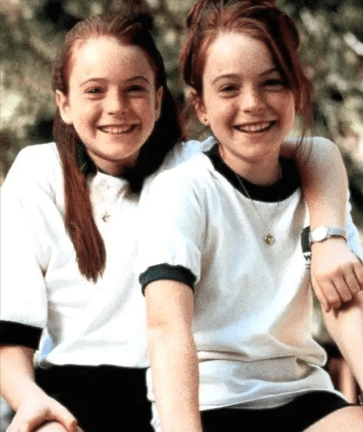
(They’re not really twins. There’s only one Lindsay Lohan!)
Rule 42.01 of the Tennessee Rules of Civil Procedure states that “[w]hen actions involving a common question of law or fact are pending before a court, the court may order all the actions consolidated or heard jointly and may make such orders concerning proceedings therein as may tend to avoid unnecessary costs or delay.”
The Court of Workers’ Compensation Claims occasionally consolidates claims, either at the request of the parties or on its own initiative. This often happens when an employee alleges multiple injuries with the same employer, perhaps with different dates of injury.
Consolidation simply allows a single trial of common issues and permits joint discovery for purposes of judicial economy. Or, occasionally claims might be consolidated for discovery only, so the parties don’t have to duplicate efforts, but then the claims are tried separately, back-to -back.
An order of consolidation has no other effect. “When cases have been consolidated, the issues remain precisely on the pleadings as they were before, and between the same parties, and are to be determined exactly as if the cases had been heard separately.” Rainbow Ridge Resort, LLC v. Branch Banking & Tr. Co., 525 S.W.3d 252, 258 (Tenn. Ct. App. 2016).
We also see consolidation of cases when more than one employer is involved. This can be appropriate because consolidation of separate actions under Rule 42.01 doesn’t create one action or make those who are parties in one suit parties in the other. However, caution may be warranted.
In Burris v. Amazon, 2024 TN Wrk. Comp. App. Bd. LEXIS 9 (Mar. 7, 2024), the employee filed separate petitions against two different employers, Amazon and WWL, for different dates of injury involving the same body part. In essence, it was a question of which employer was responsible for benefits. On motion from the employers, the cases were consolidated, but a problem arose during the expedited hearing.
The employers offered different medical depositions into evidence, while the self-represented employee offered none of his own. WWL’s doctor suggested Amazon was responsible for the injury, but Amazon’s doctor attributed the injury to WWL. Each employer objected to the other’s deposition on the grounds that it wasn’t submitted by a party in their case. Because the employee didn’t object to either transcript, the trial court admitted them both and ordered Amazon to provide benefits.
The Board vacated the trial court’s order, explaining that because consolidated claims remain separate actions, the employers weren’t parties to the other’s claim. Thus, only a party to each particular claim could offer evidence as proof in that claim. Because the employee didn’t offer the depositions into evidence himself, the only transcript properly admitted in each case was the one that didn’t support his claim. Therefore, he was left with no medical proof of causation.
Burris is probably a rare situation, but the case is a good reminder to make sure that you offer all the necessary proof for each part of the consolidated case.
Finally, I can’t seem to do a blog without mentioning settlements. If the court consolidates cases that later settle, please remember that each case is still a separate action. So you’ll need a separate set of settlement documents and a filing fee for each one.
Enough with the tortuous cautionary tale and dull procedural instructions. Let’s get back to The Parent Trap.
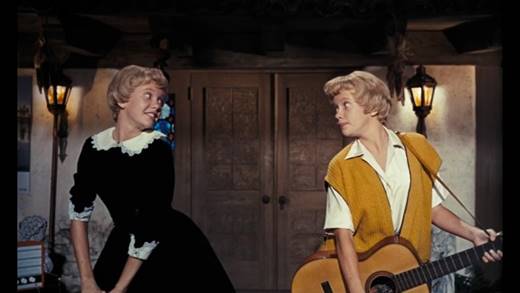
Although I’m old enough to remember the first one, I’m also the right age to have a kid that loved the 1998 Lindsey Lohan remake. It’s a cute film, although I may have gotten a little jaded after the first 20 or 30 viewings.
But I still got a kick out of the references to the original film, like when Lohan’s character sang a phrase of “Let’s Get Together” while waiting for the elevator. Also, Joanna Barnes, who played the evil fiancée in the first film, also played the mother of the evil fiancée in the remake (and her character in each film was named Vicky).
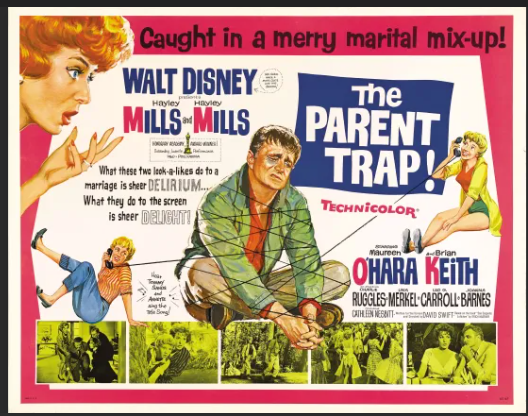
Next week: A lesson on contract law by Herbie the Love Bug. (Kidding).

 From the Bench