By Jane Salem, staff attorney, Nashville
“COMES NOW, a staff attorney for the Court of Workers’ Compensation Claims (“Staff attorney”) by and through the undersigned, and pursuant to her employment, hereby submits this blog post to facilitate attorneys-at-law in writing better briefs.”
You’re bored already, right? Translation: A staff attorney writes this blog post so your trial briefs are more inviting for the judge to read.
Note the emphasis on “trial.” I’m not speaking for the Appeals Board. They prefer formality, as evidenced by their opinions. Also, an appellate brief follows a stricter format: a table of contents, table of authorities, jurisdictional statement, etc. Importantly, the Appeals Board places no page limits in their rules.
But we do!
Since March, Rule 0800-02-21-.20(3) limits trial briefs to 10 pages, double-spaced, using a 14-point font and one-inch margins. We resorted to that level of specificity because some practitioners used micro-fonts and nonexistent margins. Tsk, tsk.
The rule allows you to move for permission for additional pages, but the judges are disinclined to grant those requests. To justify the additional pages, the issues must be numerous, complex, and/or novel. The legal issues in our cases have a standard commonality. Only something really different requires more pages to explain.
This means you, practitioners, must cram your best persuasive writing into just ten pages. You must be concise. And remember, you’ll have a chance to argue your position fully in your closing; no limits there. You’ll be fully heard.
So, below are some ways to cut your word counts to meet that page count.
Avoid legalese or wordy phrases.
The plain English movement in legal writing has been around for decades. Yet, most of the briefs we see are full of legalese, because you were told that in law school or by the senior partner at your first attorney job. Here are a few examples and how to simplify them:
- “Exhibit A, attached hereto” —> “Exhibit A.”
- “Wherefore, premises considered…” —> “So” or “Therefore.”
- Employee “would show that” —> Employee “will prove.”
- “Arguendo” —> “Arguably.” (Same number of words, but the self-represented employee understands.)
- “In order to prevail” —> “To prevail…”
- “In the event that” —> “If.”
- “Pursuant to” —> “Under.” (I know… this last one really hurts….but let it go!)
Skip the boring procedural summations.
I pinky-swear that we know the procedural posture of every case we try.
“Employee filed a Petition for Benefit Determination on August 19, 2024. A Dispute Certification Notice was filed on February 27, 2025. Employee filed a Request for Hearing on April 2, 2025. This honorable Court set the compensation hearing for July 15, 2026.”
Those 43 words tell us nothing. You could’ve spent that space explaining why your client should prevail. And thanks for calling the judge “honorable,” but flattery will get you nowhere.
Skip the elementary legal principles.
Here’s a prime example: “This Court is obliged to construe Tennessee’s Workers’ Compensation Law fairly, impartially, and in accordance with basic principles of statutory construction favoring neither the employee nor the employer.”
We know this one! It’s one of the main reasons this Court exists.
Or “the employee bears the burden of proof.”
If you’re arguing that the employee didn’t meet this burden, that’s fine—end your analysis with that sentence. But you don’t have to remind us up front when reciting the law.
Skip the needless detail.
Just convey the basic facts tailored to the issue. Please don’t tell us everything from every doctor visit.
For example, if the sole dispute is medical causation, we don’t need to know about restrictions—we want causation statements, or point out their absence.
In an accepted claim, we don’t need the details of how the accident occurred. (My favorite is when the employee “heard a ‘pop.’”) Remember, some of this can be conveyed through testimony.
Skip the “helping” or “linking” verbs.
Use “editing” and “find” to locate “is, am, are, was, were, been, be.” Then delete them and adjust the “action verb” they’re paired with. Two words are now one.
Cut your quotes or paraphrase.
Some deponents (especially doctors) are famously verbose. Some appellate judges are, too. Use ellipses often!
If the issue is the employee’s entitlement to recommended surgery, explain the statute (paraphrase) like this: “The employer must furnish surgery made reasonably necessary by the accident.” That can replace the 67-word text of subsection 50-6-204(a)(1)(A).
Don’t try to get around the rule with footnotes.
You’re thinking, “Hey, why don’t I just put that ‘extra’ argument—the worst one—into a footnote?”
Please don’t. Justice Antonin Scalia famously disliked footnotes. I’m speaking for myself and not the whole Court when I say, I’m with him. It’s distracting when my eyeballs are jumping up and down the page.
More importantly, the judge will see through this—just like they did with the micro-fonts and margins. If it’s important, fit it into the 10 pages, in the body of the brief.
Edit and proofread.
Of course, you should do this. But also, ask a coworker, spouse/partner, BFF, offspring… and/or someone who isn’t a lawyer. Stress that it needs to make sense and be concise and grammatically correct. If your non-lawyer friend can’t understand your writing, neither can a pro se litigant.
Then use the “Spelling and Grammar” tool. Followed by “Read Aloud.” Sit back with a snack or comforting beverage. Listen to your work. You’ll be surprised how well you can spot missing or wrong words when your work is read to you.
No one’s going to rule against your client because of that typo in a brief. But they’re distractions, like speed bumps. Something’s gone terribly wrong if we’ve forgotten what you’re arguing because we’re deeply tempted to pull out a red pen and start fixing your brief.
Brownie points for creativity.
Perhaps once a year, if we’re lucky, someone files a brief with a flow chart or table or some other device to assist the court’s understanding… and we love It!
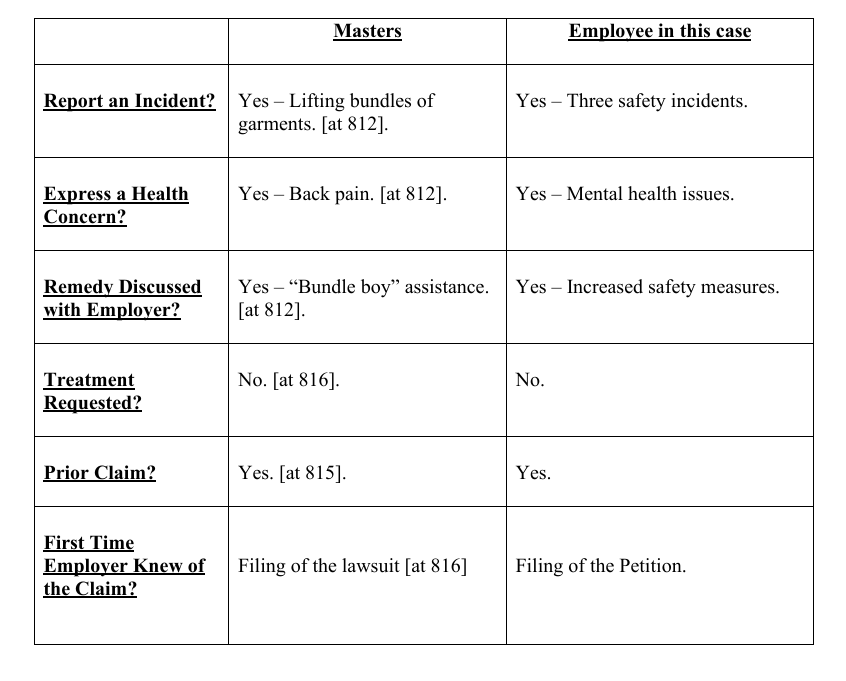
Above is an example from an actual brief. The employer’s attorney argued that notice wasn’t timely and compared the employee’s actions to Masters v. Industrial Garments Mfg. Co.
It was easier to conceptualize the argument when conveyed in words and visually. (Hint: AI loves to generate visual aids…but use it with caution.)
Conclusion.
I’ll take my own advice on concision and stop now. I’ve given you a license to forget some of the stuff you learned in law school; use it!
Respectfully submitted,
Jane

Sunset at Radnor Lake, Nashville. Photo by me.


Fantastic guidance!
LikeLike