By Jane Salem, staff attorney, Nashville
It’s not about the money. Or is it?
Last Thursday, the Appeals Board held virtual oral arguments where the dollars and cents of the issues came up more than once. Specifically, the Board probed an employee’s right to a second opinion after an authorized doctor recommends surgery. Does the authorized physician need to order a second opinion in writing? And when can an employee’s attorney receive a fee award in helping an injured worker enforce an open medical benefits agreement?
The defense’s position
The Board is reviewing two opinions in McCool v. Professional Care Services. (Click here and here). In the case, Professional Care Services didn’t authorize McCool’s request to see another doctor after her authorized treating physician recommended surgery. The employer contended that because the doctor didn’t “order” a second opinion examination in writing, it didn’t have to give her one.
The trial court disagreed and ordered Professional Care Services to authorize the second opinion, and the employer appealed.
The Board must interpret this statute:
“When the treating physician or chiropractor refers the injured employee, the employee shall be entitled to have a second opinion on the issue of surgery and diagnosis from a physician or chiropractor from a panel of two (2) physicians practicing in the same specialty as the physician who recommended the surgery.”
Attorney Brayden Hunter told the Board that because the statute says “refers,” that triggers an obligation for the doctor to make a written referral for a second opinion. It’s unambiguous, he said, and no different than when a doctor wants an employee to undergo physical therapy or surgery: “It needs to be expressly stated.”
Presiding Judge Timothy Conner pointed out that the statute is narrowly tailored, and the rest of the subsection discusses surgery and who can provide the second opinion. Read as a whole, he suggested, isn’t the legislative intent clear?—that in those distinct circumstances, an employee is entitled to a second opinion from another specialist?
Not necessarily. Hunter agreed that a second opinion examination is “treatment,” but it “expressly needs to be ordered, just like any other aspect of treatment.”
So, Judge Conner followed up, if a doctor were to have an informal conversation with a worker about surgery, the employee asks for another opinion, and the doctor says, “that’s reasonable,” that’s not enough to compel an employer to provide one? No, said Hunter. “A simple conversation is not the same as ordering treatment,” he said.
The writing is important, Hunter reasoned, because “it allows an employer to react. We can approve it; we can deny it; we can send it to utilization review; we can challenge it. If an employee is able to unilaterally request treatment based on a lack of any kind of an order, then it is a massive carve out that doesn’t comply with the rest of any treatment in workers’ compensation.”
Judge Meredith Weaver made a practical observation (read: money). “Counsel, what is the rationale in denying a $400-second opinion and instead litigating a case all the way to an appeal?”
Hunter said, “Yes, while the monetary amount might be small, the ramifications are quite large. Because this does not come down to an instance of how much it costs. It comes down to what can my client or any employer be compelled to do under the law?” He added that it’s unfair to expect the money involved to guide the outcome.
The plaintiff’s position
McCool’s lawyer, Jonathan May, vehemently disagreed, saying Professional Care Services was playing a “shell game.”
He argued that the record as a whole showed that this doctor did make a written referral by discussing the second opinion in his office note. Oddly, the surgery was authorized, but the second opinion wasn’t. Further, May maintained that even if he’d sent a letter to clarify the doctor’s intentions, Professional Care Services wouldn’t agree to its admissibility at the post-judgment compensation hearing. So that would require a deposition, which costs $1,500 at a minimum, that he or his client would have to advance. Meanwhile, McCool has waited for 14 months for a second opinion.
Even if this subsection is a “carve-out,” it exists for good reason, May said. “The legislature recognized that putting yourself through surgery is a particularly difficult decision. It’s a conversation that I have with injured workers all the time. No one wants to have surgery. There are inherent risks that your doctor tells you all about: going under general anesthesia; the risk of death; paralysis; etc. That’s not true of getting an MRI or of doing physical therapy.”
May maintained that it is about the money, and employers/carriers “making the system as burdensome as possible, because however many advantages their clients have under this statute, it’s not enough. And what they need is for people to throw their hands up and say, ‘I’m just not dealing with this anymore.’”
Because the case involves the enforcement of an open medicals provision of a prior approved settlement agreement, the only way an injured worker’s counsel can get paid is through an order that the employer pay his fees.
May framed this as an access-to-justice issue. “If people can’t get help enforcing the orders of the Tennessee Workers’ Compensation Courts, then the orders are not going to be honored, “ he said. “And I talk to people every day about settling their cases with open medical benefits, and they express anxiety about, ‘Well I’ve been through all these things just to get to this point: the utilization review, the denials, etc. Why would I believe that after we’ve gone to court, and the court says I have open medical benefits, that I’m not going to be put through the same wringer—except that you’re not going to be there to help me?’”
In this case, the judge didn’t award fees because the statute permits them when an employer “[f]ails to furnish appropriate medical . . . treatment or care . . .provided for in a . . . judgment[.]” The judge reasoned that a second opinion is an evaluation seeking an opinion, not care or treatment.
May took issue with that rationale, noting that Professional Care Services wrote in its brief that a second opinion isn’t treatment despite what defense counsel said during his arguments.
Regardless, “The idea that [a second opinion] is not medicine or physical therapy doesn’t change the way that it is treatment in the same way that an MRI is a tool used to gather more information to make better decisions in the provision of overall care.”
The opinion
The Reform Act took effect 11 years ago, so issues in the post-judgment posture are starting to bubble up with greater frequency.
The Board has 45 days from the date of oral argument to release its opinion. The outcome will answer an important question on the procedure for employees to obtain second opinions. Medical professionals and adjusters need an answer to whether a writing is necessary for a second opinion as well. Further, an answer to the fee issue will certainly be of great interest to parties and practitioners alike.
Look for a later blog post once the Board makes its decision.
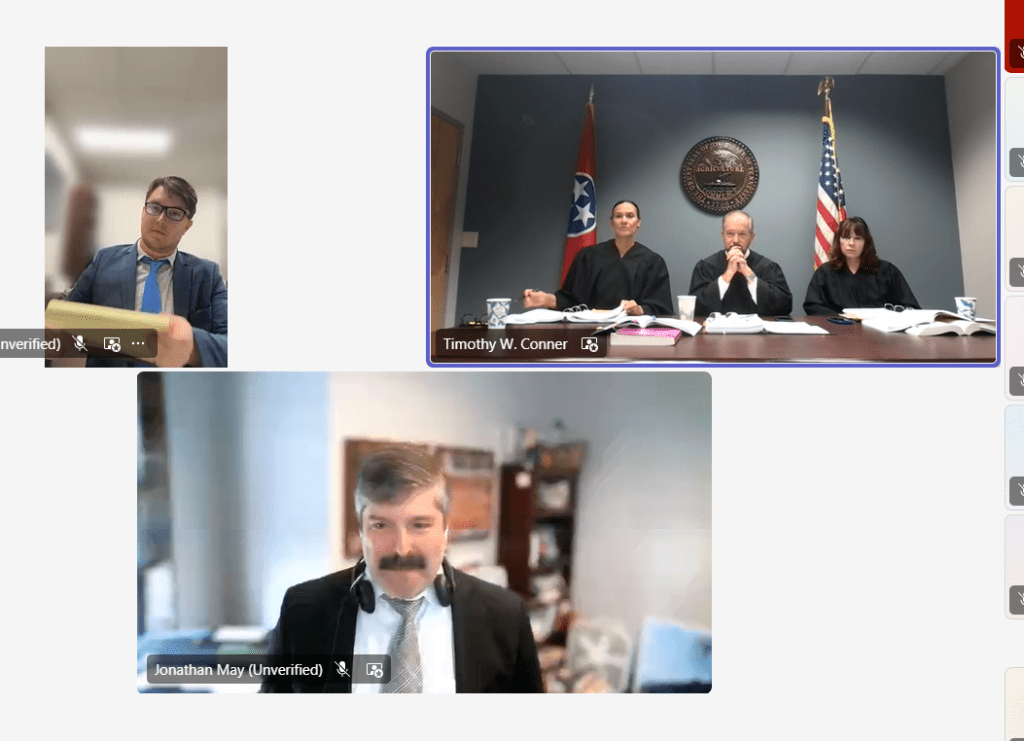
The Board heard virtual arguments on September 23. Top left: Brayden Hunter for Professional Care Services; Top right: Judges Pele Godkin, Timothy Conner, and Meredith Weaver. Bottom: Jonathan May for Ms. McCool.

 From the Bench
One thought on “Board Hears Arguments about Second Opinions, Fees”