By Kaitlynn Lehman, 3L, Belmont University College of Law

I spent this summer interning with the Bureau of Workers’ Compensation. Last year I recapped the Appeals Board’s oral arguments at the annual education conference. This year I’m back, with a closer look at one of the Board’s more complex cases: Taylor v. Dale’s Recycling.
The issue: Did Darrell Taylor’s sudden death at work, after a traffic stop and physical exertion, qualify as a compensable heart attack under Tennessee workers’ compensation law?
Taylor was hauling a high-side hydraulic dump trailer loaded with about 39,000 pounds of scrap metal, when a local deputy pulled him over on the highway because pieces of scrap were falling from the trailer.
The deputy instructed Taylor to secure the load. While Taylor worked in the summer heat, the deputy stepped away to take a phone call. When he returned, he found Taylor dead inside the trailer. He saw no signs of trauma, no one witnessed the event, and no autopsy was performed. A post-mortem investigation listed cardiorespiratory arrest as the cause of death, with hypertension and diabetes as contributing conditions.
The trial court found Taylor’s death compensable, focusing largely on the medical proof. The judge accepted Taylor’s expert’s opinion on medical causation over Dale’s Recycling’s expert. Dale’s Recycling appealed.
Employer’s Arguments
Interestingly, the medical proof wasn’t the main focus of the arguments. Rather, Richard Clark, counsel for Dale’s Recycling, began by saying, “The entire case hinges on whether or not… a professional CDL-licensed driver being pulled over in a routine traffic stop… is an abnormal stress.” He argued that CDL drivers are trained to expect stops and that nothing about this one was out of the ordinary.
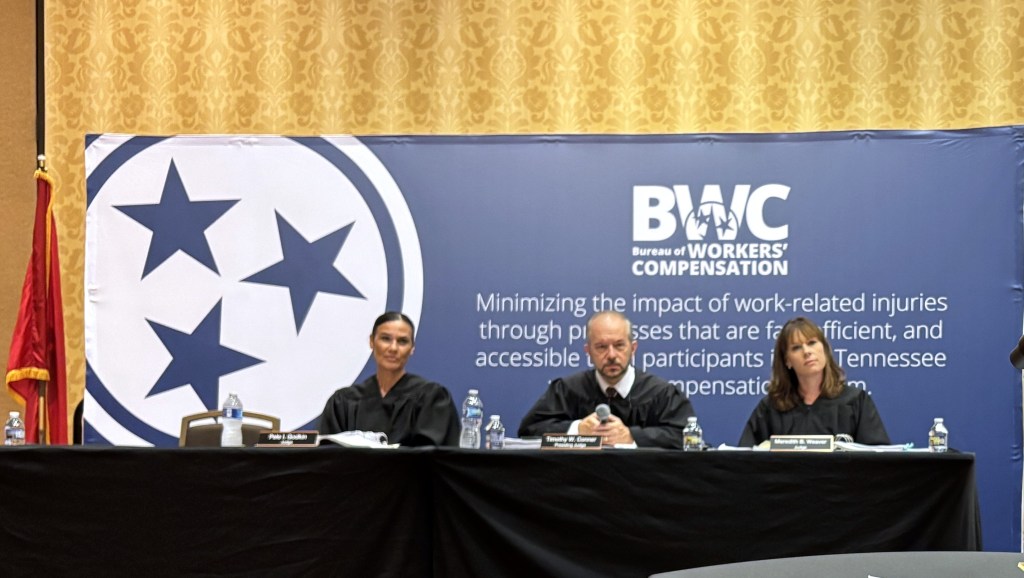
Left to right: Judge Pele Godkin, Presiding Judge Tim Conner, and Judge Meredith Weaver.
Citing Cunningham v. Shelton Security Service, Inc., Clark explained that, unless there’s a threat or confrontation, a traffic stop like Taylor’s doesn’t rise to the level of an “unusual mental stimulus.”
Clark made an analogy to his own line of work. “I absolutely hate standing in front of crowds and speaking, … but if what I’m feeling right now causes me to drop dead of a heart attack, I don’t think anyone would say that’s an abnormal event for a lawyer.”
He argued the trial court failed to conduct the necessary analysis from Mitchell v. Bunge North America. That precedent, he said, demands separate analyses of the physical and emotional stressors, each tied to medical proof. Skipping that step, Clark said, was an “abuse of discretion.”
Why does the sequence matter? Because, according to Clark, the record contains no doctor who pins the cardiorespiratory arrest on either factor alone; the employee’s expert offered only a combination theory. If neither single factor clears the “primary cause” bar, Clark concluded, the entire causation opinion collapses.
Presiding Judge Conner noted that climbing into the trailer and shifting the load, tasks outside Taylor’s usual duties, could be viewed as unusually strenuous physical activity for him.
Clark conceded that the Board could reach that conclusion, but he added that to show that those physical stressors were the primary cause, a doctor had to say so, and no doctor did in this case.
Clark questioned whether Taylor died of a heart attack, even as Judge Conner pointed out that both Dr. Arcot for the employer, and Dr. Kanagasundaram (Dr. K.) for the employee, testified to a high probability that he died of a sudden cardiac event. Clark countered that because no autopsy was performed and the coroner’s report listed only cardiorespiratory arrest, not myocardial infarction, no confirmed cause was given.
Employee’s Arguments
Jonathan May, counsel for Taylor, opened by stating that it is “quite literally impossible” to find that either the physical or the mental stressor, standing alone, could be the primary cause of Mr. Taylor’s cardiac arrest. “We cannot have two things that are each greater than 50% the cause of something,” he said.
May emphasized that both the statute and Mitchell require a holistic approach, one that “consider[s] all known causes.” However, before he could continue, Judge Meredith Weaver dove straight in with questions.
She noted the lack of an autopsy or eyewitness and pointed out that the medical proof rested on probability, not certainty. May replied that Dale’s Recycling had ample opportunity to request an autopsy if it questioned the cause of death. Instead, the company accepted the coroner’s conclusion and repeated it verbatim in the First Report of Injury, which it only filed after Mrs. Taylor filed her petition for benefits, 47 days later.
Judge Conner then cited Rule 703 of the Tennessee Rules of Evidence, stating “that a trial judge is to disallow opinion testimony if the underlying facts and data are untrustworthy.” With no autopsy, no eyewitness to the heart attack, and no confirmed diagnosis, how could Dr. K’s opinion meet that threshold?
May maintained that the facts and data Dr. K relied on were trustworthy. He said Dr. K’s opinion was based on three independent sources: Taylor’s medical records from the months leading up to his death, the deputy’s account, and the coroner’s report, which noted no other obvious cause of death. May added that even if Dr. K had relied solely on Taylor’s medical records, that alone would’ve been sufficient.
Judge Conner then turned to Dr. Arcot’s testimony that physical exertion alone can’t cause a heart attack without preexisting plaque buildup. If the plaque was already there, wasn’t it Mr. Taylor’s preexisting condition and not the work that triggered the rupture?
May called Dr. Arcot’s findings “absurdity,” pointing out that under Dr. Arcot’s logic, no worker with any preexisting condition could ever qualify for benefits. He reminded that under Mitchell, preexisting conditions don’t bar recovery.
However, May did acknowledge that Dr. K never denied the presence of plaque, but he emphasized that Taylor had been managing his health well and that his blood pressure, cholesterol, and A1C were all excellent. Meaning, Taylor’s heart condition was stable; the combination of the intense physical exertion from climbing 14 feet up into a trailer to rearrange scrap metal in the heat, plus the emotional stress of being pulled over, triggered the cardiac arrest.
As for the traffic stop, May disagreed that it was routine, stating that foreseeability doesn’t make an event ordinary. “It’s foreseeable that a cashier might be robbed at gunpoint,” he said, “but it doesn’t change the fact that when it happens, it’s unusual and… causes a physiological response.”
Judge Conner then asked whether the “unusual mental stimulus” standard should be judged from Taylor’s viewpoint or that of a reasonable CDL driver. May answered, “Either one supports compensability.” Whether subjective or objective, the stress would be abnormal under both standards.

Attorneys Richard Clark and Jonathan May confer. Photos by Kyle Jones, Bureau of Workers’ Compensation.
Okay, but if only one stressor, emotional or physical, was legally insufficient on its own, would that sink the entire claim? May said no. The statute demands the court consider “all known causes,” and Mitchell doesn’t require each stressor to reach the primary-cause threshold independently. Mitchell declined a cumulative analysis because neither stressor was present in the facts. Here, May said both clearly were.
May closed by urging the Board to build upon Mitchell. That case, he argued, was the result of bad facts. This one presents a better vehicle to convey the law on heart attacks caused by a mix of stressors. The statute allows for combination causation, and May said this is exactly the kind of case it was written for.
The Decision
The Board affirmed, concluding that Taylor’s death arose primarily from the combination of the emotional stress of the roadside traffic stop and the physical exertion of climbing into his trailer to secure loose scrap.
First, the Board brushed aside the employer’s “traffic stops are foreseeable” defense, noting that “nothing in the record suggests that this particular stop was merely an ordinary stress of [Mr. Taylor’s] job as a truck driver.” A/k/a, “foreseeability” doesn’t equal “ordinary.” Deputy Poteet’s unrebutted testimony showed that Taylor was visibly anxious and nervous, and the company confirmed Dale’s drivers hadn’t recently been pulled over to secure loads and that loading scrap wasn’t part of Taylor’s job description.
Second, the lack of an autopsy didn’t derail causation. Both cardiologists agreed Taylor suffered a sudden cardiac event, and Tennessee workers’ compensation law requires only a preponderance of the evidence, not absolute certainty. The Board agreed with the trial court’s decision to credit Dr. K, noting that “determinations by a court as to what constitutes an abnormal or unusual mental stressor are fact specific.” Dr. K’s analysis considered and explained all known causes, and it contained the more probable explanation of the cause of Mr. Taylor’s death.
Parting Words
I’m grateful for the opportunity to observe oral argument. It’s always thought-provoking, and dare I say, entertaining? And law school can never replicate real life. As a very old song goes, “Ain’t nothing like the real thing.”
Heading into my 3L year, I’m reminded that the learning never stops; even seasoned attorneys still get nervous; and for every question that looks like it has one answer, a good lawyer keeps five ready.

 From the Bench