By Jane Salem, staff attorney, Nashville
Yesterday, the Appeals Board reversed a trial court order excluding an expert’s testimony as a sanction for failure to meet a deadline to “disclose.”
In Ariel Taylor v. Coca Cola Bottling Company, the trial court held that the employer failed to comply with a scheduling order and excluded its vocational expert, in a claim seeking increased benefits.
The scheduling order, issued in March of this year, read in part as follows:
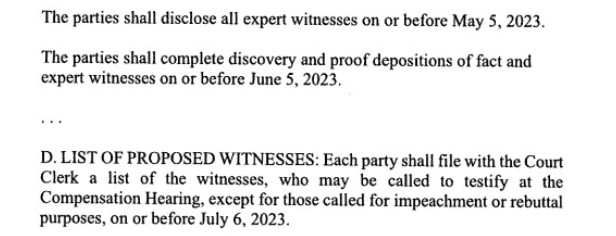
The order didn’t specify when the parties had to exchange expert reports.
Immediately after the scheduling hearing, Coca Cola’s counsel e-mailed Taylor’s attorney to schedule a vocational evaluation with its expert, whom it identified in the e-mail. Taylor attended the evaluation, and Coca Cola sent a copy of its expert’s report after the May 5 deadline for disclosure, but before the deadlines for expert depositions and the identification of testifying witnesses.
Taylor filed a motion to exclude, which the judge granted. Coca Cola appealed.
The Board held oral argument in the case earlier this month, where counsel debated the meaning of the word “disclose.”
Coca Cola contended it was in “strict compliance” with the scheduling order because it identified and placed Taylor on notice of its vocational expert via the e-mail it sent after the hearing. Ultimately, the Board agreed.
The Board wrote that the question in the case is narrow: whether the word “disclose” as used in the scheduling order is ambiguous and subject to more than one reasonable interpretation. In other words, did Coca Cola’s e-mail identifying its vocational expert comply with the plain language of the trial court’s order, or, as Taylor argued, did the word “disclose” necessarily require Coca Cola to also summarize the expert’s anticipated testimony by the stated deadline?
The Board opted for the former, writing: “[W]e conclude that the word ‘disclose’ as used in this scheduling order was ambiguous, especially given that the court set later deadlines for discovery and depositions of witnesses and for the identification of ‘testifying’ witnesses.”
So, the appellate judges concluded that Coca Cola’s e-mail identifying its vocational expert complied with the May 5 disclosure deadline.
The Board pointed out that the trial judge had reasoned that Coca Cola’s e-mail suggested an intent to schedule a vocational evaluation with its expert, but not that the expert would be called at trial. The judge also pointed out that Coca Cola shared its report 10 days after the deadline and hadn’t requested an extension of time.
But, the plain language of the order stated only that the “parties shall disclose all expert witnesses” on or before May 5, the Board countered. The order didn’t state that “expert reports or a summary of expert opinions” must be disclosed by that date. It also didn’t specify, define, or limit the parameters of the disclosure, nor did it cite to the Tennessee Rules of Civil Procedure “to guide the parties’ understanding of the terms of the scheduling order.”
Further, the trial court set a later deadline for completing “discovery” and “proof depositions” of both lay and expert witnesses, and it set an even later deadline for the identification of witnesses expected to testify at trial.
The Board concluded, “Employer provided a copy of its expert’s report before the ‘discovery’ and deposition deadline.”
The opinion is a reminder to trial judges to be precise in conveying deadlines, and for attorneys and parties to seek clarification if they’re not sure about them during the scheduling hearing. If it’s after the hearing, file a motion when guidance or an extension is needed.

Fall is in full swing near Shy’s Hill in Nashville.

 From the Bench